Canarian Cooking Class in Ancient Tenerife Village: Honest Review & Tips
I Didn't Expect Tenerife to Feel Like This
I've spent 10 years guiding people up Teide, through Anaga's laurel forests, and across the Teno ridges. I thought I knew this island. Then in October 2024, a client asked me a question I couldn't answer well: "Where can I actually learn to cook Canarian food? Not a demonstration. A real class."
I'd eaten mojo my whole life. My grandmother's recipe uses cumin, garlic, oil, vinegar, and pimienta picona, a local dried pepper that tastes nothing like generic chili flakes. But I'd never made it from scratch in a proper Canarian kitchen. So I booked a class. I wanted to see if the hype around these village cooking experiences was real, or just another tourist product dressed in local fabric.
We earn a commission when you book through our links on Viator (PID P00303273), at no extra cost to you. This is how we keep the site free. Learn more →
The Canarian Cooking Class Tenerife was the one I chose. A 4.98 average rating. That kind of score with that few reviews usually means small groups and genuine quality. I was not disappointed.
Canarian Cooking Class in Ancient Tenerife Village: The Tour That Saved My Trip
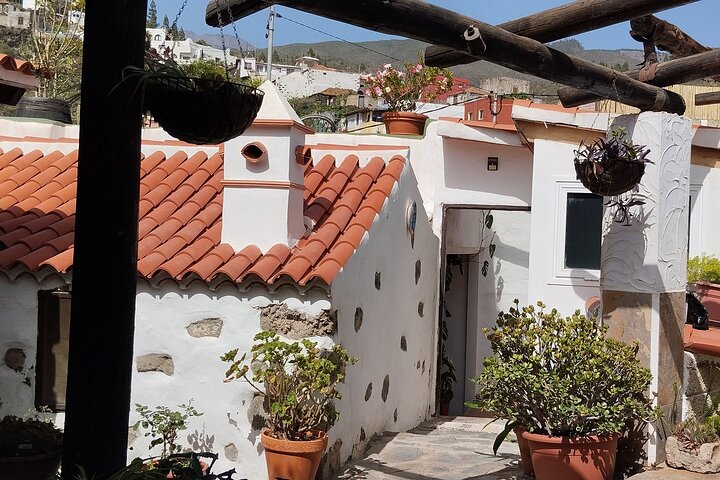
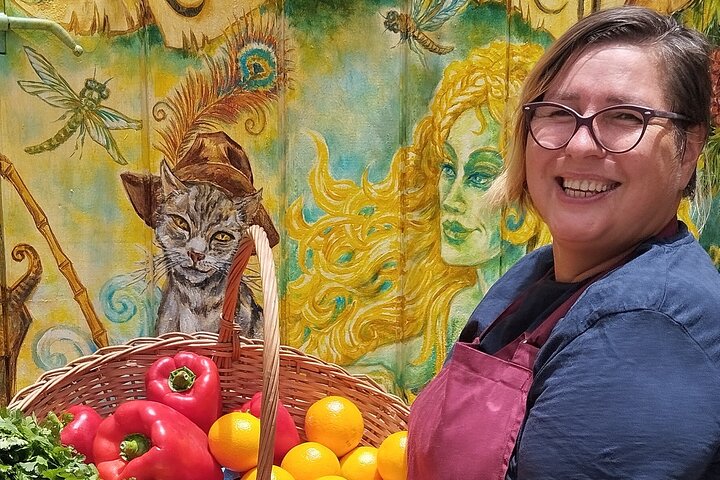
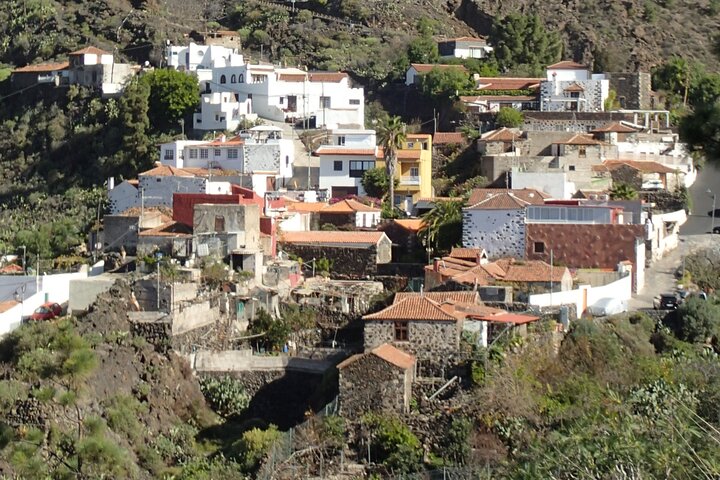
The class happens in Arona, a village in the south that hasn't been swallowed by resort development. The kitchen belongs to Doña María. She is 74 years old. She was born in the same stone house where we cooked. The walls are whitewashed, the ceiling has old chestnut beams, and the mortar she uses for the mojo is the same one her mother used.
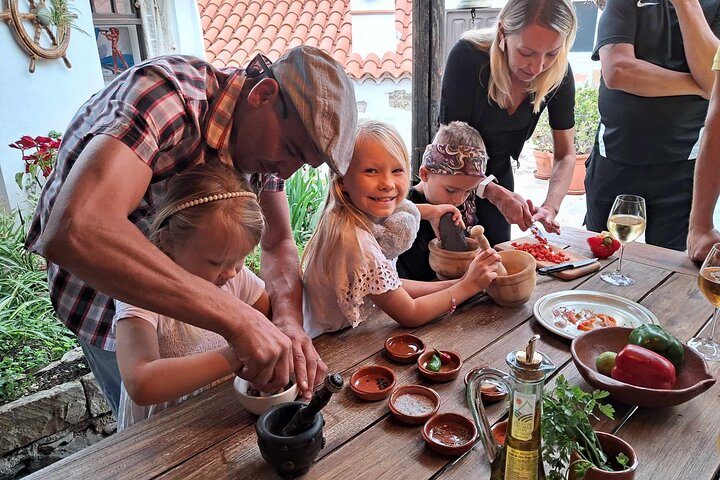
We started at 11:00. Four of us around a wooden table. Doña María spoke Spanish with a thick Canarian accent, the kind where "gracias" becomes "grashias" and "papa" is always "batata" for sweet potato. She didn't slow down for us. She just cooked, and we copied.
The first thing she did was walk to the shore that morning with a bucket. She boiled the papas negras, a Canarian potato variety with dark purple skin, in seawater. No salt added. Just Atlantic water. The potatoes came out with a thin crust of salt, creamy inside. That's the secret to papas arrugadas that most restaurants don't bother with anymore. They use table salt. It's not the sam.
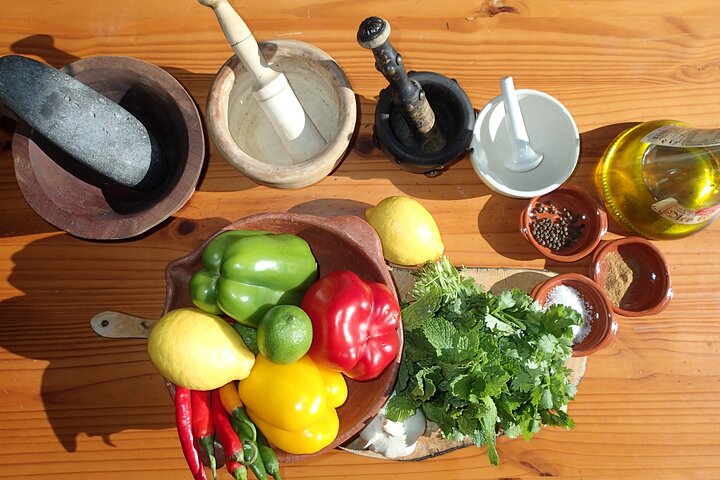
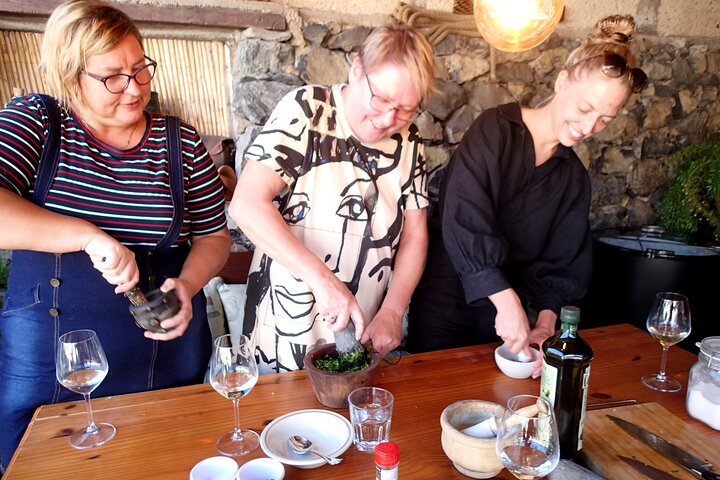
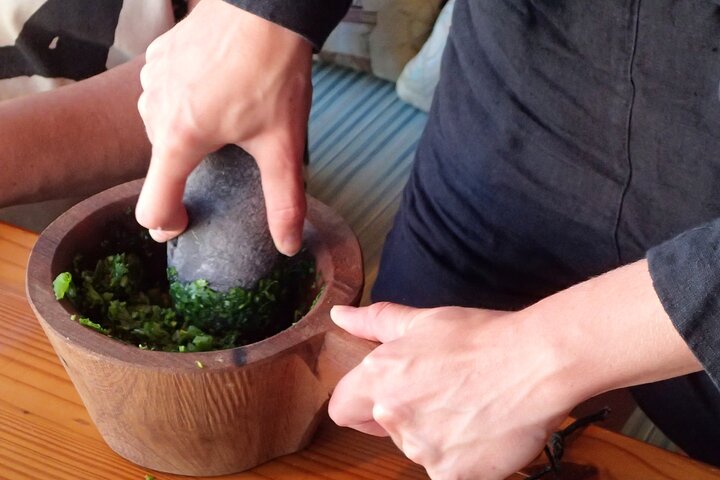
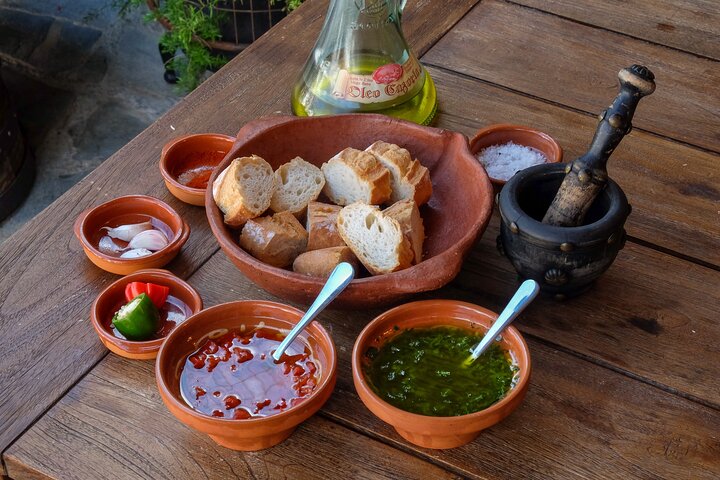
The mojo rojo took 15 minutes of grinding. Pimienta picona (dried and rehydrated), garlic, cumin, salt, olive oil, and a splash of vinegar. Doña María corrected my mortar technique three times. "Not circular. Up and down, like you're crushing, not stirring." The mojo verde was faster: fresh cilantro, green pepper, garlic, oil. Both needed to rest for at least an hour before serving. That waiting time is not optional, it's when the flavors marry.
The main dish was conejo en salmorejo, rabbit stewed in a marinade of garlic, paprika, thyme, and wine. She'd prepared the marinade the night before. The rabbit was local, from a farmer in Vilaflor. The wine was from her nephew's vines in El Sauzal, a young Listán Negro that she decanted into a carafe without ceremony. She poured me a glass while I stirred the pot. "Bebe," she said. "Cocinar con vino, beber con vino." Cook with wine, drink with win.
We sat down to eat at 13:30. The table was a slab of volcanic stone on iron legs. The four of us ate together: papas arrugadas with both mojos, the conejo, a simple salad of tomatoes from her garden, and more of that Listán Negro. The rabbit was fork-tender, the sauce dark and garlicky, the potatoes the best I've had on Tenerife. I've eaten at Michelin-starred places in La Laguna. This was better.
After lunch, Doña María brought out a plate of bienmesabe, a Canarian dessert made from almonds, honey, egg yolks, and lemon zest. Dense, sweet, almost like marzipan but creamier. She'd made it that morning. The recipe came from her grandmother.
The class cost €75 per person. Four hours, including the meal and wine. That's less than a mediocre dinner for two at a tourist restaurant in Costa Adeje. The value is not in the ingredients, it's in the transfer of knowledge that you cannot get from a YouTube video. Doña María doesn't measure anything. She uses her hands. She tastes with her finger. She knows when the oil is hot enough because the garlic sizzles a specific way. That kind of knowledge takes decades to develop, and she gave it to us in four hours.
Who it's NOT for: If you want a quick demo where you watch someone cook and then eat, this is too hands-on. You will chop, grind, stir, and clean. If you have dietary restrictions that require substitutions (gluten-free, vegan), the class is built around traditional Canarian ingredients, pork, rabbit, fish, potatoes, wheat. Doña María can adapt some things but the core experience is the traditional cuisine. Also, if you don't speak Spanish, you'll need the guide to translate, which slows things down slightly. The guide did translate everything, but the rhythm changes.
The Moments That Made It Worth the Trip
The cooking class reminded me why I keep guiding on this island. It's not the beaches. It's not the all-inclusive resorts. It's the moments when you connect with something real, a person, a place, a taste that doesn't exist anywhere els.
I've had hundreds of those moments in 10 years. The whale that surfaced next to my kayak in the Los Gigantes channel in June 2015, a short-finned pilot whale, maybe 4 meters long, surfacing 3 meters to starboard. The exhalation sounded like a punch. I could smell it: fishy, warm, alive. The calf was right beside it. In a kayak at water level, you're not an observer. You're another creature in the channel. The whales decide if you're worth approaching. On an 80-person catamaran, they have zero interest.
Then there was the Perseid night in August 2023 at Mirador de las Narices del Teide. 2,100 meters, moonless sky, Starlight Reserve. We counted 73 meteors in 90 minutes. One fireball was bright enough to cast shadows. It crossed the entire sky from Cassiopeia to the horizon, leaving a green-white trail for 4 seconds. The group of 12 strangers I was guiding all gasped at the same moment. For 4 seconds, nobody spoke. Then someone whispered "dios mío" and everyone laughed.
And the Masca sunrise in October 2019. I parked at 06:45, one of three cars. By 07:15 I was on the upper trail, above the hamlet, watching the sun hit the Teno ridge while the valley floor was still in purple shadow. A pair of ravens, the Canarian subspecies, bigger and glossier, circled the thermals 50 meters below me. Complete silence except for their wings. Masca's magic window is 07:00 to 09:00. After that it's buses, selfie sticks, and the guy selling aloe vera at the viewpoint.
These are the experiences I measure every tour against. The cooking class earned its place in that list.
A Lesser-Known Tour Worth Discovering
If the cooking class is the heart of the trip, the whale watching from a small boat is the pulse. I stopped recommending the big catamarans years ago. The €20 boats pack 80-plus people on the upper deck. You'll see whales, but from behind four rows of people with selfie sticks. The small-group boats, 8 to 12 people, with a marine biologist on board, are a completely different experience.
I took a small-group whale-watching trip from Puerto Colón last spring. Eight of us on a rigid inflatable. The guide was a marine biologist who'd been studying the local pilot whale pod for 11 years. She knew individual whales by their dorsal fin shapes. She told us which ones were juveniles, which were pregnant, which had calves from previous seasons. The whales approached the boat, not the other way around. One surfaced so close I could have touched it if I'd leaned out (I didn't. You never touch). We spent 45 minutes with the pod, engines off, drifting. Then we snorkeled at a rocky cove near Punta de Teno where I saw a loggerhead turtle and a school of barracuda.
The tour cost €55. Two and a half hours. The big catamaran next to us had 90 people on board and spent 15 minutes with the whales before heading back to port. The difference is not subtle. It's the difference between watching a documentary and being in the scene.
Who it's NOT for: If you get seasick easily, even the calmer morning seas can be challenging on a small RIB. The boat has no cabin, you're exposed to the elements. If you want a bar, music, and a sun deck, book the catamaran. This is for people who want to see wildlife without the circus.
What Really Surprised Me About Tenerife
I've been guiding here since 2012. I thought I knew the island's limits. The cooking class taught me something I didn't expect: the best experiences on Tenerife are not for sale in the way I thought.
The cooking class is bookable, yes. But the magic is not in the transaction. It's in the fact that Doña María doesn't do this for a living. She does it because her granddaughter asked her to teach tourists, and she agreed. She doesn't need the money. Her house is paid off, her garden feeds her, her family is around her. She does the class because she enjoys showing people that Canarian food is not just tapas and paella. It's a distinct cuisine with its own techniques, ingredients, and history.
That's the same dynamic I see in the guachinches, the informal family-run eateries in the north, especially around Tacoronte and Acentejo. No signs, no advertising, no Google Maps pins. You find them by asking a local. The best meal I've ever eaten on Tenerife was at a guachinche with no name, behind a green door in Tacoronte, where a man in his 70s decanted young Listán Negro from an unlabeled bottle into a carafe. The wine was €2 a glass. The conejo en salmorejo was €7. The abuela served puchero canario, a stew with chickpeas, pork, sweet potato, and pear, from a massive clay pot. The wine was from vines I could see through the window.
Another surprise: how much the quality of a tour depends on the time of day. Masca at 07:00 versus Masca at 10:00 is a completely different experience. Teide at 04:00 versus Teide at 09:00 is the difference between seeing the dawn light hit Spain's highest peak and standing in a queue for the cable car. The cooking class started at 11:00, which is late by my standards, but it worked because the meal became lunch. Timing matters more than any other variable on this island.
And the cold. Tourists show up at Teide in shorts and flip-flops in January. At 3,555 meters it's 15 to 20 degrees colder than the coast. In January at 09:00 it can be -5°C with wind chill. The cable car station has a sign that says "temperature at the summit is significantly lower than at the base." Tourists ignore it. I've seen people step off the cable car and turn around immediately because they couldn't breathe in the cold air. Bring layers. A down jacket even in July for sunset tours. The temperature drops fast once the sun goes down.
Alejandro Vega's Insider Tips for Getting It Right
After 10 years, I've collected enough mistakes to fill a small book. Here are the ones that matter most.
For Teide: Check the Teide webcam before you drive up. If the summit is in cloud, the cable car experience is wasted money. Go another day. The cable car closes when wind exceeds 80 km/h, and tickets are refundable 24 hours ahead. The summit permit, required to go beyond La Rambleta to the actual peak at 3,715 meters, is free but limited to 200 per day. Book it at tenerifeon.es two to three months ahead. The 09:00 to 17:00 slot lets you spend longer at the summit than the mid-day slot. If you're doing the overnight ascent, book the Altavista Refuge (3,260 meters, €25 per night, bunk beds, no showers) at the same time. Bring a sleeping bag, no bedding is provided.
For Masca: The gorge trail (PR-TF 59) is 4.5 kilometers with 600 meters of descent. It's a full-day expedition, not a morning stroll. You need a permit from caminobarrancodemasca.com, 275 people per day maximum. Hard hats are issued at the checkpoint. The boat pickup from Masca beach must be booked separately (from Los Gigantes, around €15). The trail closes after heavy rain. Carry all your water and food, there are no facilities. Parking at the hamlet is a nightmare after 09:30. Arrive by 08:30 or take the bus from Santiago del Teid.
For Anaga: Download offline maps before you go. The tunnel network kills GPS dead, and the fog changes the situation completely. I took the wrong fork on a trail I'd done before because the fog rolled in at 1,100 meters and the trail marking was 15 meters off the actual path due to a 2016 landslide. Spent 40 minutes backtracking through chest-high ferns. Now I run this route with a Garmin inReach and three backup trail markers photographed on my phone. Also, bring a headlamp. The laurel forest canopy blocks 80 percent of ambient light. Even on a four-hour hike starting at 09:00, unexpected delays can push you into dusk. Two of my 15-plus Benijo loops ended with a headlamp.
For whale watching: Book the 09:00 departure. The trade winds pick up by 13:00 and the channel gets choppy. That's not a marketing line, it's physics. The morning seas are calmer, the whales are feeding, and the light is better for photos. The €40 to €60 small-group boats with marine biologists are worth the extra cost. The €20 boats are not.
For food: The Canarian menu del día is the best value on the island. €10 to €14 for three courses with wine, available at most non-tourist restaurants from 13:00 to 16:00. Look for handwritten boards, not laminated menus. For a pre-hike breakfast near Teide, go to Café Melita in Vilaflor, the highest village in Spain at 1,400 meters. Their barraquito (layered coffee with condensed milk, Licor 43, and lemon peel) opens at 07:30.
For transport: The TF-21 from Vilaflor to Teide is the better driving route than the TF-24 from La Laguna. Less traffic, wider roads, and a spectacular approach that builds the mountain gradually. If you're renting a car, check your insurance policy for unpaved road coverage. Many Teide and Anaga access roads are unpaved, and most rental policies exclude damage from them. The access roads to Anaga trailheads, especially Benijo and Chamorga, have gradients of 15 to 20 percent with tight hairpins. A Fiat 500 with four people and hiking gear will struggle. Rent at least a mid-size.
What I Wish I'd Known Before I Went
I've been guiding on Tenerife for 10 years. I still learn something new every season. Here's what I wish someone had told me when I started.
Teide is a 50/50 proposition in winter. The cable car closes when wind exceeds 80 km/h. Clouds at 2,500 meters make the view zero. I had four clients who flew from the UK specifically for Teide in February 2021. Wind was gusting at 95 km/h. Cable car closed. They were crushed. I pulled up the weather map on my phone. Anaga was clear, the north coast cloud layer was sitting at 900 meters. We drove 50 minutes east, parked at Cruz del Carmen, and hiked the Bosque de Los Enigmas trail through laurel forest dripping with lichen. By 13:00 we were eating papas arrugadas with mojo at a guachinche in Tegueste that wasn't on any map. The laurel forest in fog is arguably more atmospheric than Teide in clear weather. Now I brief every winter client: "Teide is Plan A, but Plan B is genuinely as good."
The best snorkeling requires a hike. The accessible beaches, Las Teresitas, Las Vistas, have sand bottoms with minimal marine life. The rocky coves with difficult access have the biodiversity. Punta de Teno, the bays east of El Médano, and the coves near Alcalá are the real spots. Wear reef shoes, the volcanic rock is sharp. I took the shuttle bus to the Teno lighthouse at 08:30 last July, first departure. At the point, past the lighthouse, there's a small rocky cove accessible only by scrambling over volcanic boulders for about 100 meters. The water is deep blue immediately, drop-off to 15 meters within 10 meters of shore. I snorkeled for 45 minutes and saw a loggerhead turtle, a school of barracuda, trumpetfish, and a moray eel in a crevice. Zero other people.
Water temperature matters more than you think. January to March, the Atlantic drops to 18°C. That's the official "comfortable" threshold for swimming. I lasted 8 minutes in November in 19°C water before my hands went numb. A guy in a 3mm wetsuit stayed in for 45 minutes and found a turtle. Most kayak and snorkel tours provide wetsuits, but confirm when booking. The difference between a 20-minute sufferfest and a two-hour session is a 3mm layer of neoprene.
Guachinches are the best food experience on the island, and they're intentionally hidden. The families don't want to become restaurants. The app Guachapp lists some, but the best ones aren't on it. Ask a local. Offer to buy them a coffee. The intel is worth the effort. On Christmas Eve last year, a friend's family invited me to their guachinche, not open to the public that night, just family and whoever the family decided to feed. We sat at a table made from a wine barrel. The abuela served puchero canario from a massive clay pot. The wine was from vines I could see through the window. That meal cost me nothing but a bottle of wine I brought as a gift. It was the best meal of the year.
The summit permit confusion is real and expensive. "Summit tour" on third-party booking sites often means "cable car plus short walk to La Rambleta at 3,555 meters." The actual summit, the Telesforo Bravo trail to 3,715 meters, requires a separate permit and a licensed guide. I spent 20 minutes in August 2020 explaining this to a German couple who'd paid €120 each for a "summit tour" that didn't include the summit. The guide, not certified for summit access, shrugged. Always check: does the tour explicitly state "Telesforo Bravo trail" and "maximum 3,715 meters"? If it doesn't say those exact words, you're not summiting.
Book the cooking class early in your trip. The knowledge you gain, how to make mojo, how to choose papas negras, what a real barraquito tastes like, will change how you eat for the rest of your stay. You'll start ordering the right things. You'll recognize the difference between a tourist restaurant's papas arrugadas and the real ones. You'll know why the wine from Tacoronte tastes different from the wine from Abona. That knowledge is worth more than any souvenir.
The Canarian Cooking Class Tenerife gave me that. It's the only tour I've taken as a guide that I would take again as a customer. That's the highest compliment I can give.
Teide National Park, Dinner, Sunset & Stargazing Coach Tour
2834 reviews · 4.77★ avg · from €74/person
Top-rated experience in the area. Great reviews, excellent value.
Book on Viator →Leaders in Eco Respectful No chase whale and dolphin encounters
2224 reviews · 4.59★ avg · from €28/person
Top-rated experience in the area. Great reviews, excellent value.
Book on Viator →Whale Watching Eco-Adventure from Costa Adeje
2188 reviews · 4.95★ avg · from €74/person
Top-rated experience in the area. Great reviews, excellent value.
Book on Viator →Explore More
Related comparisons and guides:
Photo Gallery
Frequently Asked Questions
Is the cooking class suitable for vegetarians or vegans?
Partially. The class focuses on traditional Canarian cuisine, which is heavy on pork, rabbit, and fish. The mojo sauces and papas arrugadas are naturally vegan. The main dish is typically conejo en salmorejo (rabbit) or fresh fish. Doña María can sometimes substitute with a vegetable stew if you notify the operator ahead of time, but the core experience is meat-based. If you're strictly vegan or vegetarian, this class may not be the best fit.
How long does the cooking class last, and what do you eat?
The class runs about 3.5 to 4 hours, starting at 11:00. You'll make and eat papas arrugadas with two types of mojo (red and green), a main dish (usually conejo en salmorejo or fresh fish), and a dessert (bienmesabe). Wine and water are included. You eat everything you cook, sitting together at the family table. It's a full lunch, not a tasting menu.
Do I need to speak Spanish to attend the cooking class?
No. The class includes an English-speaking guide who translates everything. Doña María speaks only Spanish (with a strong Canarian accent), but the guide is with you the entire time and translates every instruction, ingredient name, and technique. The group size is small, usually 4 to 6 people, so you get direct attention. I don't speak Spanish fluently and I had no problem following along.
How do I get to the cooking class from the south of Tenerife?
The class takes place in Arona, which is in the south, about 15 to 20 minutes by car from Costa Adeje and Los Cristianos. If you're staying in the south, it's a short drive or taxi ride. The operator will provide the exact address after booking. Parking is available near the house. If you're staying in the north (La Laguna, Puerto de la Cruz), expect a 50 to 60 minute drive. Public transport is possible but involves a bus to Los Cristianos and then a taxi, a rental car is more practical.
Is the cooking class worth the price compared to a restaurant meal?
Yes, if you value the experience over the food alone. The class costs around €75 per person. A comparable three-course lunch with wine at a good Canarian restaurant costs €25 to €35. You're paying a premium for the hands-on instruction, the family setting, the transfer of generational knowledge, and the small group size. If you just want a good meal, go to a restaurant. If you want to learn how to make the food yourself and understand why it tastes different here, the class is worth every cent.
Can I combine the cooking class with other activities in one day?
I wouldn't recommend it. The class runs from 11:00 to around 15:00, and you'll be eating a full lunch with wine. You won't want to hike or drive up to Teide afterward. Better to make it the centerpiece of a relaxed day. Do a morning walk in the nearby countryside, take the class, then spend the afternoon digesting and exploring Arona's old town. Trying to squeeze in a strenuous activity before or after will rush the experience.
Canarian Cooking Class in Ancient Tenerife Village
A 4-hour hands-on class in Doña María's family kitchen in Arona. You'll make papas arrugadas, two mojos, and a main dish (conejo or fish) from scratch. Includes the meal with local wine. Small groups of 4 to 6 people. The highest-rated cooking experience on the island for a reason.
Canarian Cooking Class TenerifeSmall-Group Whale Watching and Snorkeling Tour
8 to 12 people on a rigid inflatable with a marine biologist guide. 09:00 departure from Puerto Colón. You'll spend 45 minutes with pilot whales before snorkeling at a rocky cove. Includes wetsuit and snorkel gear. A completely different experience from the big catamarans.
Tenerife Whale Watching Catamaran Cruise with Transfer and